

Eco Surf! Transforming plastic bottles in Stand-up Paddle Boards
- 28 de fev. de 2018
- 4 min de leitura
The second socio-environmental action of EcoHospitality NZ for the New Zealand community was a success!
Still in Brazil, before we moved to New Zealand, we knew a project developed by Eco Garopaba that transform PET bottles into surfboards. A genial idea that we never forgot and we always say to our friends.

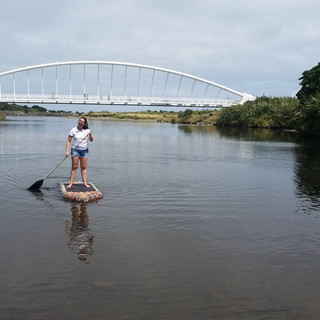
After we landed in New Zealand and started working with sustainable tourism solutions in the country we noticed that here was an ideal place to replicate the project. After all we are on an island, surrounded by water and with many rivers and lakes...
The project benefits to the environment:
- Avoids that lots of plastic bottles end up polluting our rivers, lakes and ocean
- Reduces the consumption of energy and water, as it prevents raw materials from being transformed to make an conventional board. At the same time also reduces the quantity of bottles that are recycled, which although it is a good destination for such, It is a process that consumes large amounts of energy and water and so it is still better to try to reuse for later, if it is not possible, recycle the bottles
- Avoids the use of large quantities of raw material that would have to be exploited and transformed for the manufacture of a conventional board
And there is benefits to the local community:
- With a low investment, less than 100.00 dollars, everyone can have access to a healthy and nature contact sport
To develop the project we needed some partners, some of which had already supported us in our first sustainability action in the city
Steve, from Upcycling Taranaki, once again helped us with the bottles and as a volunteer during the workshop, About Image and Tento Media helped us, respectively, with banner and photos and filming of the workshop, The Seaside Market provided us once again the space and we had two new partners for this project:
Cork Bodyboarding that supplied us with a hand-made wooden fins and the Gorilla Glue that supplied the glue.

But we must not forget the help we had from the New Plymouth community in this project. Especially the people who visited our space and contributed in some way, either by sanding or cutting bottles or even giving a word of support and also to Sally, a resident of the city who answered our request for the donation of a gazebo and coincidentally works in a place where they use a specific type of bottle that we need and that was very difficult to find.
After having all the necessary bottles and the partners, it took two Sundays to finish the surfboard and it was really cool! Many people came to learn more about the surfboard and many others take part in the construction of it.
Our biggest difficulty during the construction of the ecoboard was the format of the bottles. That ones we used in the Brazilian project were more flat, so that the construction of columns and collage of one column in the other are easier with the flat bottles, but in the end, despite this difficulty, the surfboard works very well.
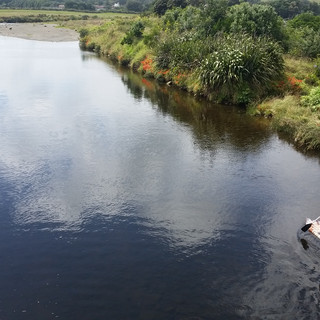
It's been pretty cool and it works, which is more important. We've tested the ecoboard in lakes, rivers and the sea and we've had no problems. The ecoSUP, moreover, is more stable than an industrial board, having as a negative point in relation to the industrial board that in days with too much wind becomes more difficult to use it.

A summary on how is the process to make the ecoboard
1 – For a standard SUP, which supports up to 100 kilos we used 50 bottles of 2.25 liters of Coca Cola. Each of them was cleaned, and stuffed using a small piece of dry ice. Then they were sanded at the top and the base
2 – Other 43 bottles of 2.25 litres of Fanta or L&P were used as connections. In the same way as the previous ones they were washed and in these case the base and the top were cut off
3 – Using the bottles alternately were made 7 columns, gluing a bottle in the other (the glue has to be a Polyurethane , water proof and expansive. We used the brand Gorilla glue and it worked perfectly)
4 – With the columns ready, we glued a column in the other. To reinforce and the columns do not loosen, we use PVC pipes between the columns, in order to give more area of contract between them and thus more area to apply the glue
5 – To finish we glue the fins and two EVA mats as a base we could stand up on the board
6 – For the oar, which needs to have a longer cable than normal, we used a oar shovel that we found in a free stuff on the street and we made the cable using bamboo
Material and Cost

For the construction of the board, as it was during two workshops involving the community, we took about 15 hours to make the whole process.
However if you make it in your home, it is possible to make the board in about 10 hours, divided in 2 days, giving so time for the glue to dry.
And this was the second socio-environmental action of the hospitality NZ in benefit of the local community and the environment. And if your company or group wants to develop a workshop like this, please contact us to talk and analyze how we can help you.






Comentários